
What printing options work best for high-end chocolate box packaging?
When choosing printing processes for high-end chocolate box packaging, gilding and embossing techniques can instantly enhance the visual impact and tactile luxury. Aluminum foil is used for hot stamping, with a thickness typically ranging from 120 to 180 nanometers. It can be transferred to the surface of chocolate box packaging with an accuracy of ±0.15 millimeters under specific conditions of 150 to 180 degrees Celsius and a pressure of 25 to 35 Newtons per square centimeter. Data shows that the application of three-dimensional embossing technology can make the depth of pattern relief reach 0.5 millimeters. This tactile difference can increase consumers' perception score of quality by more than 30%. For instance, Godiva employs a multi-gilding combination in its limited edition collection, which makes its attention capture rate on the shelves 65% higher than that of ordinary packaging.
Spot color printing and Pantone color matching systems are the cornerstones for ensuring brand color consistency. Using Pantone spot color ink, the color matching accuracy ΔE value can be controlled within 1.0, which is far lower than the threshold of ΔE=2.3 that the human eye can recognize, thus ensuring that the color deviation rate of each batch of 100,000 chocolate box packages produced is less than 0.5%. According to a survey of 500 consumers, chocolate box packaging with high color saturation and unique spot colors (such as metallic or pearlescent colors) can increase consumers' purchase intention by 25%. Brands like Lindt will customize exclusive color cards for their seasonal products to ensure that the color fluctuation range of their signature red under different lighting conditions does not exceed 3%.
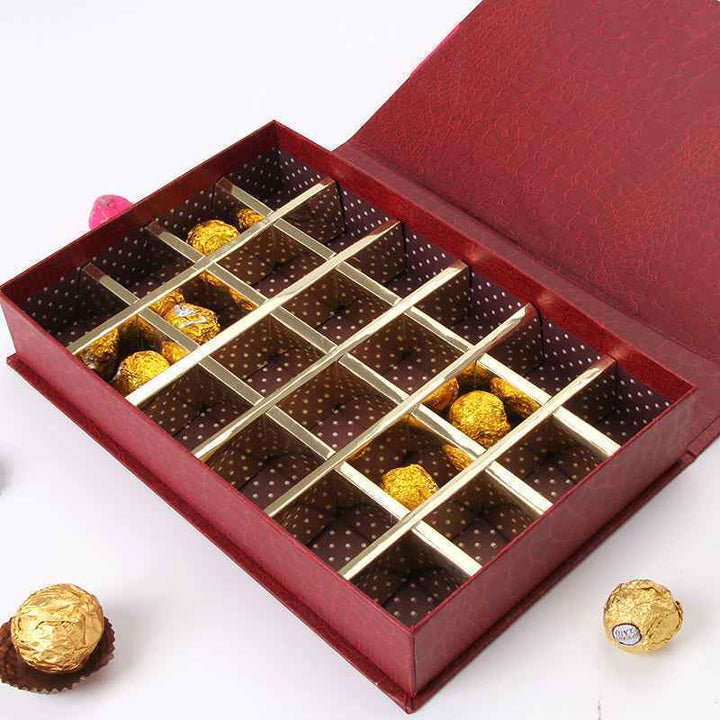 UV flexographic printing and gravure printing technologies perform exceptionally well in high-definition image reproduction. UV flexographic printing can achieve a resolution of up to 200 lpi in line count, keeping the dot gain rate below 12% and ensuring minimal loss of image details. During the 50-kilometer-long printing process of gravure printing, the ink density fluctuation can be controlled within ±0.05, achieving nearly perfect uniformity. Referring to the fine patterns on Ferrero Cinza chocolate packaging, its printing precision enables the minimum text size to reach 1.5 pounds while still maintaining 100% clarity. This technology enhances the adhesion of ink to 95%, enabling the packaging to have a wear rate of less than 2% after 5,000 cycles in the transportation friction test.
Screen printing brings a unique thick texture and special effects to chocolate box packaging. Through a screen with a mesh count as high as 350 mesh per inch, an ink layer with a thickness of 15 to 20 microns can be deposited, which is 5 to 8 times that of ordinary offset printing. This thickness makes it possible to achieve special effects such as a frosted texture, ice flowers or cracks, enhancing the uniqueness of the packaging by 40%. For instance, Nils uses screen printing of local varnish to achieve a glossiness difference (GU value) of 80 for specific patterns on the packaging, creating a strong visual contrast. The printing speed of this process is approximately 1,500 sheets per hour, which is lower than the 10,000 sheets per hour of offset printing. However, it is highly suitable for small-batch, high-value-added customized production.
Sustainable printing solutions are becoming the new standard in the high-end market. The VOC (Volatile Organic Compounds) emissions of water-based inks and soybean oil-based offset printing inks can be reduced by 70% compared with traditional inks. According to a consumer survey in 2023, chocolate box packaging using FSC-certified paper combined with eco-friendly ink can increase a brand's environmental image score by 35% and attract 28% of environmentally conscious consumers to be willing to pay a 10% premium. Innovative digital printing technology now allows the minimum order quantity to be reduced to 100 pieces and shortens the production cycle from the traditional 21 days to 5 days. At the same time, through precise toner or ink control, the material waste rate has been reduced from 15% in traditional plate-making to less than 3%, providing brands with a chocolate box packaging solution that combines aesthetics, efficiency and environmental responsibility.
UV flexographic printing and gravure printing technologies perform exceptionally well in high-definition image reproduction. UV flexographic printing can achieve a resolution of up to 200 lpi in line count, keeping the dot gain rate below 12% and ensuring minimal loss of image details. During the 50-kilometer-long printing process of gravure printing, the ink density fluctuation can be controlled within ±0.05, achieving nearly perfect uniformity. Referring to the fine patterns on Ferrero Cinza chocolate packaging, its printing precision enables the minimum text size to reach 1.5 pounds while still maintaining 100% clarity. This technology enhances the adhesion of ink to 95%, enabling the packaging to have a wear rate of less than 2% after 5,000 cycles in the transportation friction test.
Screen printing brings a unique thick texture and special effects to chocolate box packaging. Through a screen with a mesh count as high as 350 mesh per inch, an ink layer with a thickness of 15 to 20 microns can be deposited, which is 5 to 8 times that of ordinary offset printing. This thickness makes it possible to achieve special effects such as a frosted texture, ice flowers or cracks, enhancing the uniqueness of the packaging by 40%. For instance, Nils uses screen printing of local varnish to achieve a glossiness difference (GU value) of 80 for specific patterns on the packaging, creating a strong visual contrast. The printing speed of this process is approximately 1,500 sheets per hour, which is lower than the 10,000 sheets per hour of offset printing. However, it is highly suitable for small-batch, high-value-added customized production.
Sustainable printing solutions are becoming the new standard in the high-end market. The VOC (Volatile Organic Compounds) emissions of water-based inks and soybean oil-based offset printing inks can be reduced by 70% compared with traditional inks. According to a consumer survey in 2023, chocolate box packaging using FSC-certified paper combined with eco-friendly ink can increase a brand's environmental image score by 35% and attract 28% of environmentally conscious consumers to be willing to pay a 10% premium. Innovative digital printing technology now allows the minimum order quantity to be reduced to 100 pieces and shortens the production cycle from the traditional 21 days to 5 days. At the same time, through precise toner or ink control, the material waste rate has been reduced from 15% in traditional plate-making to less than 3%, providing brands with a chocolate box packaging solution that combines aesthetics, efficiency and environmental responsibility.
UV flexographic printing and gravure printing technologies perform exceptionally well in high-definition image reproduction. UV flexographic printing can achieve a resolution of up to 200 lpi in line count, keeping the dot gain rate below 12% and ensuring minimal loss of image details. During the 50-kilometer-long printing process of gravure printing, the ink density fluctuation can be controlled within ±0.05, achieving nearly perfect uniformity. Referring to the fine patterns on Ferrero Cinza chocolate packaging, its printing precision enables the minimum text size to reach 1.5 pounds while still maintaining 100% clarity. This technology enhances the adhesion of ink to 95%, enabling the packaging to have a wear rate of less than 2% after 5,000 cycles in the transportation friction test.
Screen printing brings a unique thick texture and special effects to chocolate box packaging. Through a screen with a mesh count as high as 350 mesh per inch, an ink layer with a thickness of 15 to 20 microns can be deposited, which is 5 to 8 times that of ordinary offset printing. This thickness makes it possible to achieve special effects such as a frosted texture, ice flowers or cracks, enhancing the uniqueness of the packaging by 40%. For instance, Nils uses screen printing of local varnish to achieve a glossiness difference (GU value) of 80 for specific patterns on the packaging, creating a strong visual contrast. The printing speed of this process is approximately 1,500 sheets per hour, which is lower than the 10,000 sheets per hour of offset printing. However, it is highly suitable for small-batch, high-value-added customized production.
Sustainable printing solutions are becoming the new standard in the high-end market. The VOC (Volatile Organic Compounds) emissions of water-based inks and soybean oil-based offset printing inks can be reduced by 70% compared with traditional inks. According to a consumer survey in 2023, chocolate box packaging using FSC-certified paper combined with eco-friendly ink can increase a brand's environmental image score by 35% and attract 28% of environmentally conscious consumers to be willing to pay a 10% premium. Innovative digital printing technology now allows the minimum order quantity to be reduced to 100 pieces and shortens the production cycle from the traditional 21 days to 5 days. At the same time, through precise toner or ink control, the material waste rate has been reduced from 15% in traditional plate-making to less than 3%, providing brands with a chocolate box packaging solution that combines aesthetics, efficiency and environmental responsibility.
Considering a commission?
A free thirty-minute discovery consultation, in-studio or by call, opens every project.