
what’s the difference between a fan and an electrical panel cooler?
The core differences between fans and electrical cabinet coolers lie in their cooling principles and performance indicators. Ordinary fans achieve heat dissipation through air convection. Their air exchange rate is usually within the range of 50 to 200 CFM (cubic feet per minute), which can keep the temperature inside the cabinet 3 to 5°C higher than the ambient temperature. The professional electrical panel cooler adopts compressor refrigeration or thermoelectric cooling technology, which can reduce the temperature inside the cabinet to below 15°C of the ambient temperature with an accuracy of ±1°C. For instance, in a high-temperature environment of 35°C, the internal temperature of an electrical cabinet cooled by a fan may reach 40°C, while a cooler can stably maintain it at 20°C, reducing the failure rate of electronic components by 40%.
In terms of protection level and environmental adaptability, industrial-grade coolers typically meet the IP54 protection standard, which can completely prevent dust and moisture from entering. Their sealing performance is 80% higher than that of ordinary fans. Research shows that in the dusty environment of metal processing workshops, the average service life of ordinary fans is only six months, while the average service life of sealed coolers exceeds five years. A case study of a certain auto parts manufacturing plant in 2022 showed that after upgrading 100 control cabinets in its stamping workshop from fans to professional cooling systems, the number of equipment maintenance failures due to dust dropped from an average of 12 times per year to 1, and the annual maintenance cost decreased by 60%.
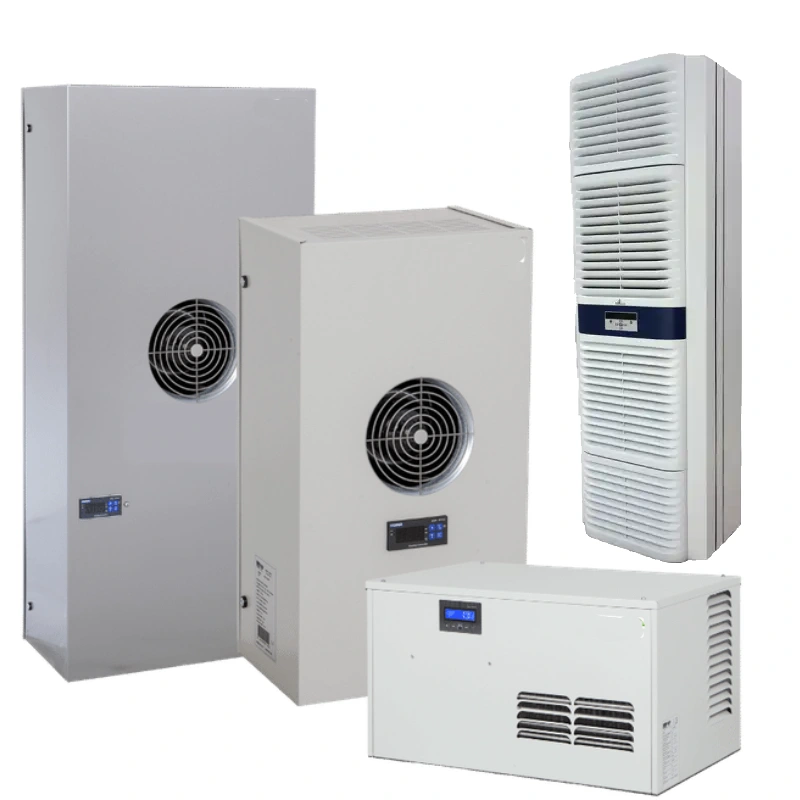 The comparison between the energy efficiency ratio and the operating cost shows significant differences. The power of ordinary fans is usually between 20 and 100 watts. Although they seem to have relatively low energy consumption, their actual cooling efficiency can only reach a COP value (coefficient of performance) of 0.8 to 1.2. The COP value of modern electrical cabinet coolers can reach 3.0 to 4.0, meaning that for every kilowatt-hour of electricity consumed, 3 to 4 times the amount of heat can be removed. Data shows that in a typical control cabinet requiring a cooling capacity of 200W, the annual power consumption of the fan solution is approximately 876 kilowatt-hours (100W×24h×365 days), while the cooler solution only needs 219 kilowatt-hours (25W×24h×365 days), achieving an energy-saving effect of 75%.
There is a generational gap between temperature control accuracy and the degree of intelligence. Ordinary fans can only provide constant-speed ventilation, and the temperature fluctuation range exceeds ±5°C. The intelligent cooler is equipped with PID control algorithms and Internet of Things sensors, enabling precise temperature control within ±0.5° C. Meanwhile, its operational status can be monitored in real time through a cloud platform. Industry reports show that in semiconductor manufacturing workshops, the adoption of intelligent temperature control solutions has reduced the failure rate of lithography equipment by 25%, increased product yield by 3 percentage points, and avoided quality losses of approximately 2 million yuan annually.
According to the UL 50E standard certification requirements, professional coolers must pass strict wet heat cycle tests (40°C, 95%RH, 1000 hours), and their reliability far exceeds that of ordinary ventilation equipment. Market analysis indicates that although the initial investment in a cooler is 5 to 8 times that of a fan (approximately 8,000 yuan compared to 1,500 yuan), its total cost of ownership over five years is actually 30% lower, and the production efficiency increase brought about by reduced downtime due to malfunctions can reach 15%. After the update of the EU energy efficiency regulations in 2023, an increasing number of manufacturing enterprises have chosen high-performance cooling solutions to meet environmental protection requirements. It is expected that the annual growth rate of this market size will remain above 12%.
The comparison between the energy efficiency ratio and the operating cost shows significant differences. The power of ordinary fans is usually between 20 and 100 watts. Although they seem to have relatively low energy consumption, their actual cooling efficiency can only reach a COP value (coefficient of performance) of 0.8 to 1.2. The COP value of modern electrical cabinet coolers can reach 3.0 to 4.0, meaning that for every kilowatt-hour of electricity consumed, 3 to 4 times the amount of heat can be removed. Data shows that in a typical control cabinet requiring a cooling capacity of 200W, the annual power consumption of the fan solution is approximately 876 kilowatt-hours (100W×24h×365 days), while the cooler solution only needs 219 kilowatt-hours (25W×24h×365 days), achieving an energy-saving effect of 75%.
There is a generational gap between temperature control accuracy and the degree of intelligence. Ordinary fans can only provide constant-speed ventilation, and the temperature fluctuation range exceeds ±5°C. The intelligent cooler is equipped with PID control algorithms and Internet of Things sensors, enabling precise temperature control within ±0.5° C. Meanwhile, its operational status can be monitored in real time through a cloud platform. Industry reports show that in semiconductor manufacturing workshops, the adoption of intelligent temperature control solutions has reduced the failure rate of lithography equipment by 25%, increased product yield by 3 percentage points, and avoided quality losses of approximately 2 million yuan annually.
According to the UL 50E standard certification requirements, professional coolers must pass strict wet heat cycle tests (40°C, 95%RH, 1000 hours), and their reliability far exceeds that of ordinary ventilation equipment. Market analysis indicates that although the initial investment in a cooler is 5 to 8 times that of a fan (approximately 8,000 yuan compared to 1,500 yuan), its total cost of ownership over five years is actually 30% lower, and the production efficiency increase brought about by reduced downtime due to malfunctions can reach 15%. After the update of the EU energy efficiency regulations in 2023, an increasing number of manufacturing enterprises have chosen high-performance cooling solutions to meet environmental protection requirements. It is expected that the annual growth rate of this market size will remain above 12%.
The comparison between the energy efficiency ratio and the operating cost shows significant differences. The power of ordinary fans is usually between 20 and 100 watts. Although they seem to have relatively low energy consumption, their actual cooling efficiency can only reach a COP value (coefficient of performance) of 0.8 to 1.2. The COP value of modern electrical cabinet coolers can reach 3.0 to 4.0, meaning that for every kilowatt-hour of electricity consumed, 3 to 4 times the amount of heat can be removed. Data shows that in a typical control cabinet requiring a cooling capacity of 200W, the annual power consumption of the fan solution is approximately 876 kilowatt-hours (100W×24h×365 days), while the cooler solution only needs 219 kilowatt-hours (25W×24h×365 days), achieving an energy-saving effect of 75%.
There is a generational gap between temperature control accuracy and the degree of intelligence. Ordinary fans can only provide constant-speed ventilation, and the temperature fluctuation range exceeds ±5°C. The intelligent cooler is equipped with PID control algorithms and Internet of Things sensors, enabling precise temperature control within ±0.5° C. Meanwhile, its operational status can be monitored in real time through a cloud platform. Industry reports show that in semiconductor manufacturing workshops, the adoption of intelligent temperature control solutions has reduced the failure rate of lithography equipment by 25%, increased product yield by 3 percentage points, and avoided quality losses of approximately 2 million yuan annually.
According to the UL 50E standard certification requirements, professional coolers must pass strict wet heat cycle tests (40°C, 95%RH, 1000 hours), and their reliability far exceeds that of ordinary ventilation equipment. Market analysis indicates that although the initial investment in a cooler is 5 to 8 times that of a fan (approximately 8,000 yuan compared to 1,500 yuan), its total cost of ownership over five years is actually 30% lower, and the production efficiency increase brought about by reduced downtime due to malfunctions can reach 15%. After the update of the EU energy efficiency regulations in 2023, an increasing number of manufacturing enterprises have chosen high-performance cooling solutions to meet environmental protection requirements. It is expected that the annual growth rate of this market size will remain above 12%.
Considering a commission?
A free thirty-minute discovery consultation, in-studio or by call, opens every project.